Some SEO changes can show early results within around two weeks, particularly on existing pages. A wider SEO strategy takes longer, and I would plan over several months, potentially twelve months or more.
At Swift & Co, we specialise in search marketing, which includes SEO. One question we regularly get asked is: how long does SEO actually take to work?
The answer depends on your website’s starting point, what needs changing and how quickly the work can happen.
There is a difference between improving a page that already exists and developing a strategy to grow your website. Both are useful, but they work on different timescales.
Can SEO Work Straight Away?
Sometimes you can make a useful change quickly. That does not mean the results will be instant.
When I look through a website, I often find straightforward improvements that were missed when it was originally built. A page might not clearly explain the service, or its wording might not reflect what potential customers are searching for.
In some cases, improving that text is enough to give an existing page a better opportunity to appear for relevant searches.
I have seen initial improvements within around two weeks, particularly when working on existing pages rather than creating brand-new ones. That is an early sign of progress, rather than a promise that every website will improve within a fortnight.
Google still needs to process the changes, and not every update produces a noticeable improvement.
Google’s SEO Starter Guide explains that changes can take anything from a few hours to several months to be reflected in search results. It recommends generally allowing a few weeks before assessing their effect.
What Does It Mean for SEO to “Work”?
Before deciding how long SEO takes, it helps to be clear about what you want it to achieve.
SEO stands for search engine optimisation. It involves helping search engines understand your website and helping people find it through relevant searches.
You might first notice your pages appearing more often on Google. After that, you may see more clicks through to the website.
But from a business point of view, the aim should be to attract people who could become customers.
More traffic is useful when it brings relevant visitors. For a service business, that might mean more enquiries. For an online shop, it might mean more purchases.
A blog post can also introduce someone to your business before they are ready to buy. A service or product page may reach someone much closer to making a decision.
That is why I would not judge SEO entirely by how many extra people visited your website. You also need to consider whether those visits are helping your business.
Why Does an SEO Strategy Take Longer?
A few changes to existing pages can happen relatively quickly. Developing your website to reach more potential customers is a bigger job.
An initial conversation with an agency might identify some obvious improvements. Looking more closely can reveal missing pages, unanswered customer questions or parts of your market that the website does not currently cover.
Those opportunities need research, planning and implementation.
Finding Gaps in Your Website
One example is a property-based company we worked with.
The website had pages displaying properties, but it did not have dedicated pages for the locations those properties were in.
That left an opportunity to create useful location pages, giving people a clearer way to explore properties in a particular area.
The work was more involved than tweaking a sentence on an existing page. The new pages needed to be planned, written and added to the website.
For a property website, useful location pages could bring together available properties and relevant information about the area. Simply copying the same page and swapping the place name would not give visitors much extra value.
The point is that an SEO strategy can uncover opportunities your website was never built to address. Turning those opportunities into useful pages takes time.
Getting the Work Implemented
The timeline also depends on who is doing the work.
Can the agency make agreed changes directly? Does your developer need to implement them? Are you writing or reviewing the content yourself?
Your knowledge as the business owner can be particularly valuable when explaining services, products or locations. However, if every page needs your input, the schedule also depends on when you can provide it.
A recommendation cannot start helping your website until it has been put into practice.
Giving New Pages Time to Develop
Publishing a page is another step in the process.
Google needs to discover and process it, and being indexed does not automatically mean it will rank prominently or generate enquiries.
If you are starting with a new website, I have covered that distinction in more detail in my guide to how long Google takes to crawl a new website.
Your competition matters too. A useful page targeting a specific local need faces a different challenge from a page competing for a broad national search.
What Work Might an SEO Agency Do?
The work should depend on what your website needs. It can include:
- Improving existing service, product and location pages.
- Researching relevant searches and identifying gaps in your content.
- Creating useful blog posts and other supporting content.
- Improving navigation and links between related pages.
- Fixing technical problems that affect access to your content.
- Checking relevant schema markup, also called structured data.
- Earning relevant backlinks and mentions from other websites.
AI Overviews are another consideration, but they still rely on the foundations of good SEO.
Google’s guidance on AI features says the same SEO best practices remain relevant, with no special optimisation required for AI Overviews or AI Mode. Useful content and accessible pages remain the starting point.
Schema should accurately describe the content on the page. Adding it does not guarantee rankings or inclusion in an AI Overview.
SEO Progress Is Not Always a Straight Line
It is tempting to expect traffic to increase every week once SEO work begins. In practice, the pattern can be uneven.
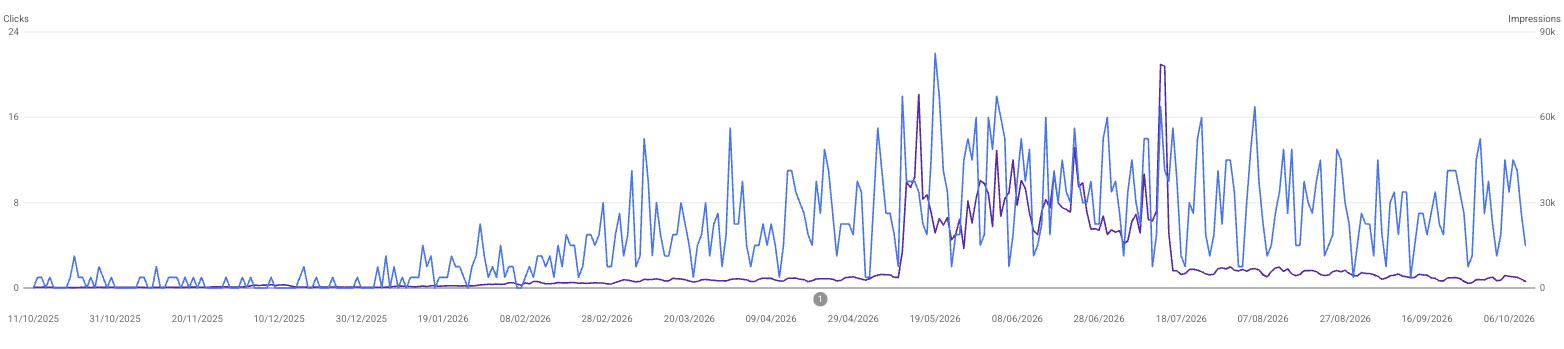
In this graph, clicks become more frequent over time, while impressions rise sharply during part of the period and later fall.
The graph alone does not explain what caused those changes. It does show why a single spike, dip or good week is not enough to judge a longer-term strategy.
Impressions tell you your pages appeared in search results. Clicks tell you people visited from those results. Neither tells you, on its own, whether those visitors became customers.
Look at the wider trend alongside the work completed and the enquiries or sales coming through.
So, How Long Should You Allow for SEO?
My broad answer is around two weeks for some early improvements, through to twelve months or more when looking at a longer-term strategy.
Those are different stages of progress:
- Early improvements: Changes to existing pages may start showing an effect within a few weeks.
- Developing the strategy: Research, new pages, content and technical work need time to be completed and assessed.
- Longer-term growth: Building a wider presence across relevant searches requires continued work and review.
Twelve months is not a deadline by which every website will have achieved its goals. Equally, you should not have to wait twelve months to understand what your agency is doing.
You should know what is being worked on, why it matters and how progress is being measured.
There will often be more useful work to do as your website develops. New opportunities appear, existing content needs updating and your business priorities can change.
My recommendation is to look for sensible early improvements while giving the wider strategy time to develop. Keep the focus on relevant traffic and business results.
If you would like help understanding what your website needs and setting realistic expectations, get in touch with Swift & Co.